Showing posts with label Birds. Show all posts

Sunday, January 29, 2012

A Discovery!

A new nest
     I apologize for the somewhat lousy photos in this post, but I'm very excited to have found a bird's nest under construction!  My husband and I spotted this nest about 7 feet up in a young pine tree.  There are grasses in it that we believe are pampas grass fronds that have been drifting around our yard since we paid a friend to remove the clumps this fall, so we're pretty sure this really is new construction.  (Actually the friend left them pretty neatly stacked in the compost bin, but I made a mess -- I'm very good at messes -- trying to chop them up smaller so they will compost faster.)
     The nest is probably a robin's, which is not particularly unusual in our yard, but it's interesting and exciting for two reasons.  First, while I knew that winter residents like robins get a jump-start on nest building, I had no idea they would start to build this early in the year.  Second, this is the first definite nest we've had in our "habitat restoration" area.  I'm putting quotes around that because this is nothing official and really a quite small area on the grand scheme of things.  But this is an area where we are encouraging native loblolly pine trees and other native vegetation to provide a natural buffer between the cultivated and utilitarian parts of our yard and a swath of tidal marsh at the back of our property.  We lost a few very large trees to storms in the first few years after we moved in and decided to plant more trees.  
Roots of a 70 foot oak felled in a Nor'Easter in 2006
We planted a lot of bare root trees from the National Arbor Day Foundation but had a lot more success when we realized that seedling pines were appearing everywhere in the new sunny gaps.  We just stopped mowing and ended up with a mini pine nursery. 
A place to sit at the end of the path
     The trees are about 10 feet tall now and the only maintenance we do is mow the main path, occasionally trim or cut some of the pines and shrubs closest to both paths (there's a wide grassy one and a narrower leaf-litter covered one), and work on keeping the invasive plants out, including sweet autumn clematis which blankets our neighbor's backyard, and Phragmites australis.  
Sunlight shining through the autumn leaves and Phragmites seedheads
     The phrag is a scourge of almost every wetland and the strip at the edge of "our" marsh has probably been there for hundreds of years (my city of Hampton, VA, bills itself as the oldest continually inhabited English-speaking community in the U.S.).  It's almost certainly not going to be eradicated anytime soon, but encouraging trees in the adjacent area has the happy consequence of limiting its spread in that direction, since Phragmites does not do as well in shade.  The pampas grass was probably not terribly invasive, but it didn't sit well in this natural habitat and I never liked it.  I don't have the lower back strength to dig out such a behemoth, though, so it was great that our friend agreed to it (thanks, Mike!) 


Wax myrtles, favorite of Yellow-rumped warblers and kinglets
    The wooded space is very green.  The dominant plants are loblolly pine and wax myrtle.  There really are not very many flowers here so many people would probably not consider it a garden.  The only blooms are some high tide bush and goldenrod in the fall and a pretty native pink mallow right around my birthday.  Even if I were not determined to keep only native plants in this area, it would be a real challenge to garden here in the traditional way since we have salt flooding seemingly every couple years now.  But this space holds its own charms for me.  It's green and pleasant all year round.  In winter, the taller oaks and sweet gums have lost their leaves so the sun shines in on the green world.  It's so sheltered that it's often pleasant enough in the middle of the day to sit back there and eat lunch even in winter.  In summer, in contrast, it is much shadier and cooler than the adjacent areas.
White-throated sparrow
  
    Best of all, it really does attract wildlife, including some that is quite unusual for a suburban backyard.  The first time I saw a wood nymph butterfly I considered that we had achieved a real woodland.  Better still, we have even seen a woodcock and an ovenbird (both only briefly during migration).  I even had a brief glimpse of a fox trotting across the path once.

Wednesday, January 11, 2012

An unlikely visitor

     My husband and I are avid birders, and enjoy seeing lots of different kinds of birds in our yard.  Our yard has its own life list in fact, with 124 species.  Just in case anyone else's yards are jealous, I should point out to be fair that our yard has a lot of advantages in this respect, including being partially within and adjacent to a tidal saltmarsh in close proximity to the Chesapeake Bay and a migratory flyway (that and admittedly liberal rules for adding birds to the list, including flyovers.)
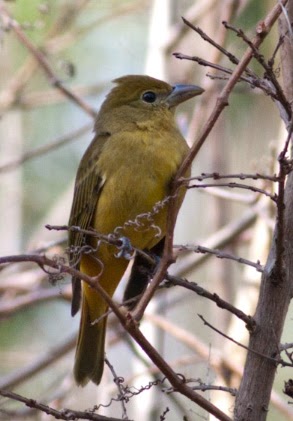
     So when we see a bird from the window that looks unusual, we tend to drop what we're doing and run for binoculars and, if necessary, field guides.  The window over the kitchen sink looks out over the backyard... we don't have as many dishes as we once did.  This weekend I looked out to see a small yellowish bird poking around a half-barrel "pond" we have on the deck.  I thought it might be a Common Yellowthroat, which would be a nice bird, but I needed my binoculars to get a good look.  Better than a yellowthroat, it was a Summer Tanager!  
     This is not at all a normal bird for this area in January.  It is called a "summer" tanager, after all.  It's a bird of the treetops, where it eats mainly insects.  It flew up into a tree but my husband was able to get some photos of it before it left.
     I love to garden (although I don't really have a naturally green thumb) and one of the things I love about it is seeing little creatures in my garden, birds and butterflies, etc.  A lot of my gardening effort and daydreaming is focused on gardening for wildlife, including planting and encouraging native plants and removing invasives (this last involves much more effort in my case than I would really like).  Doug Tallamy, in his book called "Bringing Nature Home," makes the point that native plants are of key importance for wildlife, especially birds, because those are for the most part the only plants that sustain large numbers of insects of various species.  Even birds that we think of as seed-eaters feed their young on protein-rich insects.  So I choose native plants wherever possible.
     But I am a gardener, and I have other interests too.  Like many others, I'm greedy for flowers and I want to have blooms all year round if possible.   In January, about all I have in bloom is the Mahonia that was planted by a previous owner of my house.
     
     I think this is Mahonia bealei, and it is not native to my area.  In the winter and early spring, it consistently attracts honeybees, which aren't native either (but are also very welcome).   I suppose the bees have somewhere else to go in the summer because I don't see them nearly as often then.  Honeybees can survive cold temperatures by huddling together in the hive, but when it's warm enough for me to be brave enough to be out sniffing the perfume of the Mahonia, it often seems to be warm enough for them too.
     It wasn't a good day to be a honeybee collecting nectar from the Mahonia this Saturday though.  But it wasn't such a bad day to be a Summer Tanager far from her usual winter home.
     Bryan also got this photo, exhibit A.  I'm not sure if this wrong-way visitor will make it through the winter if she can't get oriented and go south.  But with the help of the non-native Mahonia and honeybees, she might have a better chance.   Gardening for the birds seems to be like that -- full of surprises.