Friday, January 20, 2012

Garden Book Review: 'The Nonstop Garden'

     HolleyGarden of Roses and Other Gardening Joys has proposed Garden Book Reviews as a subject for blogging on the 20th of each month.  I'm totally game, since I'm a sucker for gardening books.  I don't think I have 109 of them yet, as she does, but I'm sure it's just a matter of time.  My newest was a Christmas gift.  It's The Nonstop Garden by Stephanie Cohen and Jennifer Benner. 
     The Nonstop Garden is a large-format book with lots of appealing glossy photos of beautiful gardens, geared toward helping beginning gardeners achieve four season interest.  The premise seems solid, that having mixed gardens with trees and shrubs, perennials, bulbs and annuals is the way to achieve a garden that is appealing at all times of year, and less maintenance to boot.  Lots of gardening books for beginners are all primer without the comfortable conversational prose that makes a garden book fun to read over and over, but this book is written in an appealing personal style while still being informative. 
     The organization of the book is good, with an introductory, motivational section followed by six chapters of plants according to type (trees and shrubs, bulbs, etc.), which is the highlight and strength of the book, and then by a section called "Finishing touches" which includes less interesting (to me) chapters on garden art and structures and a final summarizing chapter highlighting tips for designing for each of the four seasons in turn.  The end of the book includes several pages of charts of various types.  
     The excellent chapters on specific plants form the lion's share of the book.  Here, the reader is treated to a series of portraits of a well-designed collection of plants.  Each chapter covers only a relatively few plant species or families, but this manageable selection is a well-chosen mix, not only of plants of different sizes and different lifecycles, but also a mix of old standbys and relatively less well-known plants.  I believe that a garden built out of just this selection of plants really would be a very satisfying four-season garden.
     The book also has some nice details, most notably the picture captions.  Most of the photos captions include a note about where the photo was taken, and this information can be compared to a list of the gardens in the back of the book.  How frequently I've been drawn by gorgeous eye-candy in a garden book only to perceive a hint of a disappointment when I begin to suspect that every single photo is taken in a garden designed by a professional designer, maintained by a large staff, and existing in England or some other impossibly mild climate.  In this book, you can check those assumptions.  OK, most of the gardens are still designed by a professional, and some are indeed botanical gardens, but not all.  Some are private gardens, and they range throughout various climate zones in the U. S.  So if you like, you can search out the pictures in a climate like your own.
     I have to admit that I don't like everything about this book.  The book features "garden designs" which are two-page spreads showing a plan view and a drawing of an imaginary garden.  Fortunately, these are sparsely spread throughout the book, rather than taking up the entire second half as in some other garden books. I guess I have a pet peeve against these things, but I would much rather see a real garden (preferably one that has made it successfully through a few years) than a drawing.  It's not the drawings I object to -- actually, I find them pretty charming -- but the unrealistic gardens they show.  Unfortunately, The Nonstop Garden's designs seem perhaps worse reflections of reality than most, especially in respect to the size of the plants.  Many of the designs in the book have some oddly sized plants, but the "Wet Feet" design almost outlandishly so.  This shows an island bed anchored by a young but sizeable sweetbay magnolia surrounded by a lush bed of other plants that appear in the drawing to all be about knee-high.  These shorties include a Virginia sweetspire (a shrub that was at least that size out of the pot when my husband planted it in our garden in November), a swamp hibiscus (about 5 feet tall in my garden) and a swamp sunflower (generally about 8 feet tall in my garden despite vigorous "pruning" by deer).  The tallest thing in the drawing besides the Magnolia looks to be maybe 3 feet at most... and it's a dawn redwood! Maybe these are the heights of the plants the day they are planted, but in that case, they should not be packed in cheek-to-jowel.  The hardest thing about garden design for beginners, I think, is not a lack of artistic vision or ignorance of so-called rules, but basic unfamiliarity with plants and what they will do in a given spot.  I think a beginner or intermediate gardener pretty much just has to grow a whole bunch of plants for years before they can really hope to implement a design that might appear in a book like this.  These color-by-number hand-drawn designs in books like these can't possibly help much, certainly not in this case.  A gardener who plants this design exactly as in the book is in for some surprises!  I suspect nobody really does that anyway, though....
Swamp Sunflower (Helianthus angustifolius) in my garden
     The charts in the back are also slightly disappointing.  Some of them give the impression that the authors were given a homework assignment they would rather not spend time on.  A page with three conversion charts is weirdly designed: conversions from inches to centimeters and from feet to meters are given as charts with a range of values given in both measurement systems.  But the temperature conversion, which is perennially difficult to remember and use, is given only as a mathematical equation, necessitating -- for most mortals -- the use of a calculator.  A chart with benchmark values would have been useful in this case, probably much more so than the length conversions.  The chart of "Peak Performance at a Glance" is a nice idea, but if this book is really for beginners, the entries really should include common names and not just Latin.  Most mystifying of all is the Hardiness Zone chart, which does not include a map!  But the list of resources and especially the Garden Credits, mentioned earlier, are much appreciated and should prove useful.
     All in all, I thought this was an enjoyable book, but I would not rank it in the top tier of gardening books.  Instead I would recommend Fallscaping, by Nancy J. Ondra and Stephanie Cohen (the latter author is also one of the authors of The Nonstop Garden).  Although nominally more limited in scope (just one season instead of four), Fallscaping provides a much richer and more satisfying armchair gardening experience. Maybe I'll review it on a future Garden Blogger's Garden Book Review Day.

Wednesday, January 18, 2012

Attracting another kind of wildlife

     Recently, some good friends came to my house for dinner with their children.  Everybody had a good time, including the kids, but as the evening progressed, my little three-year-old friend seemed a bit stressed out.  It was close to bedtime and the excitement was taking its toll.  On their way out, they passed the "Golden Showers" yellow rose that blooms by my front porch.  The spot is in a very warm microclimate in a sunny sheltered spot and, between that and the unusually warm winter we've been having, the rose had bloomed as late as December.  The first hard frost in mid-December freeze-dried the blooms, some of them just as the buds were starting to unfurl, so although they were not as beautiful as before the freeze, there were some that were still pretty.  (Needless to say, I was too lazy to deadhead them.)  My little buddy pointed and asked, "What's that?"  Her mom told her it was a rose and I asked, "Do you want one?" I clipped off the best of the dried blooms and gave it to her.  The big smile on her face was a joy to see.  It reminded me how important it is to involve kids in gardening and nature.  Do you have ideas how to get kids interested in plants and wildlife?  I would love to hear about them.
"Golden Showers" Rose (before the frost!)

Sunday, January 15, 2012

Bloom Day - January 2012


Paperwhite
     Happy Bloom Day!

     I found more options than I expected in my garden this Bloom Day.  I didn't expect to find any fresh paperwhites.  They were blooming nicely in December, but we finally had the first hard frost and now there only a few nice blooms.  Can't be too greedy in January, though. 
     I still consider myself a beginner gardener (I won't say how long I've been in that stage, because it's too embarrassing).  I learn a lot by trial and error (mostly error).  I had assumed that paperwhites were not hardy outdoors.  Several years ago, I found daffodil bulbs sprouting in the compost.  At first I assumed squirrels or even garden fairies had hidden them there for their own mischievous ends, but it gradually dawned on me that they were my discarded paperwhite bulbs that I had forced indoors for a mid-winter flower fix.  I'm fairly sure I didn't need to see them in bloom before I figured it out ....  I moved them and they've been healthy and multiplying ever since.  The blooms are a little bit hit-or-miss, and last year they didn't bloom because all the buds were destroyed by frost.  Other years they have just waited until January to start.  This year we had a very late first hard frost and the paperwhites were gorgeous in December.  In the first week of December, I had ginger lilies (Hedychium coronarium) and paperwhites blooming in my garden at the same time.  The weather here in Southeastern Virginia always throws some exceptional surprises, and this winter is no exception.
Carolina jessamine (Gelsemium sempervirens)
Quince
     After the frost, I'm not so lucky.  I'm hunting around but finding mostly single blooms.  There are a few early blooms on the Carolina jessamine and the Quince.
     I thought Mahonia might be all I would have in bloom right now.  It's not at it's peak yet, but there are enough open florets to attract honeybees, and last week the honeybees attracted an unexpected avian visitor.  The fragrance of the Mahonia flowers is strong and perfumy, even in the cold.  I love fragrant flowers and try to stop and take a stiff whenever I go past, but the Carolina jessamine flowers that are open right now are too high up for me to reach.  They don't seem to be quite as fragrant when it's cold as the paperwhites or Mahonia.  But when the whole vine is covered in blooms, the fragrance wafts down and can be smelled by anyone coming and going through the front door.  I can hardly wait!  
Mahonia bealei (I think)

     I love Bloom Day!  If you don't know about Garden Blogger's Bloom Day, definitely check out May Dreams Gardens.  I found it because I was searching for plants that would bloom at a certain time.  When I found the Bloom Day posts, I felt like I hit the jackpot!  Now I check it out various garden bloggers Bloom Day posts all the time, or even just do Google searches on "Bloom Day August" (or whatever month I'm stuck on) to try to get ideas what to add to my garden.  Or just to dream about a more floriferous time.  Getting out and taking timely photos of my own garden has also been good for me.  This month it was so cold that I needed the motivation to get outside. A few months ago it was perfect gardening weather, but then I needed extra motivation to take a break and actually look around!  It's because of Bloom Day that I decided to start this baby blog.  I just wish I had been brave enough in October and November when I still had lots of flowers!  
Rosemary (:Tuscan Blue")
     Another nice thing about going out to take a look is that I sometimes find something unexpected. I have a few more January blooms left to show.  I didn't think about the periwinkle or rosemary until I went out to look. 

Periwinkle (Vinca major)
     The berries on the nandina and holly are very bright and cheerful, too, and there are lots of darling little daffodil greens starting up, like Mary Lennox's "green points".  I have a large swath of larkspur sprouts that I keep daydreaming about, and a surprising amount of winter foliage on other plants as well: groundcovers, hellebores, hurricane lilies, and even sundrops.  The last photo is of a plant that I put in specifically for its winter foliage.  I'm keeping an eye on it because after I planted it I learned that it can be invasive, but so far it has not gone anywhere in my garden.
Arum italicum

Wednesday, January 11, 2012

An unlikely visitor

     My husband and I are avid birders, and enjoy seeing lots of different kinds of birds in our yard.  Our yard has its own life list in fact, with 124 species.  Just in case anyone else's yards are jealous, I should point out to be fair that our yard has a lot of advantages in this respect, including being partially within and adjacent to a tidal saltmarsh in close proximity to the Chesapeake Bay and a migratory flyway (that and admittedly liberal rules for adding birds to the list, including flyovers.)
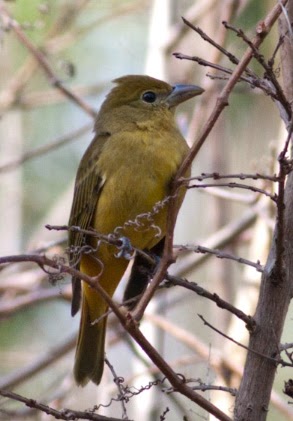
     So when we see a bird from the window that looks unusual, we tend to drop what we're doing and run for binoculars and, if necessary, field guides.  The window over the kitchen sink looks out over the backyard... we don't have as many dishes as we once did.  This weekend I looked out to see a small yellowish bird poking around a half-barrel "pond" we have on the deck.  I thought it might be a Common Yellowthroat, which would be a nice bird, but I needed my binoculars to get a good look.  Better than a yellowthroat, it was a Summer Tanager!  
     This is not at all a normal bird for this area in January.  It is called a "summer" tanager, after all.  It's a bird of the treetops, where it eats mainly insects.  It flew up into a tree but my husband was able to get some photos of it before it left.
     I love to garden (although I don't really have a naturally green thumb) and one of the things I love about it is seeing little creatures in my garden, birds and butterflies, etc.  A lot of my gardening effort and daydreaming is focused on gardening for wildlife, including planting and encouraging native plants and removing invasives (this last involves much more effort in my case than I would really like).  Doug Tallamy, in his book called "Bringing Nature Home," makes the point that native plants are of key importance for wildlife, especially birds, because those are for the most part the only plants that sustain large numbers of insects of various species.  Even birds that we think of as seed-eaters feed their young on protein-rich insects.  So I choose native plants wherever possible.
     But I am a gardener, and I have other interests too.  Like many others, I'm greedy for flowers and I want to have blooms all year round if possible.   In January, about all I have in bloom is the Mahonia that was planted by a previous owner of my house.
     
     I think this is Mahonia bealei, and it is not native to my area.  In the winter and early spring, it consistently attracts honeybees, which aren't native either (but are also very welcome).   I suppose the bees have somewhere else to go in the summer because I don't see them nearly as often then.  Honeybees can survive cold temperatures by huddling together in the hive, but when it's warm enough for me to be brave enough to be out sniffing the perfume of the Mahonia, it often seems to be warm enough for them too.
     It wasn't a good day to be a honeybee collecting nectar from the Mahonia this Saturday though.  But it wasn't such a bad day to be a Summer Tanager far from her usual winter home.
     Bryan also got this photo, exhibit A.  I'm not sure if this wrong-way visitor will make it through the winter if she can't get oriented and go south.  But with the help of the non-native Mahonia and honeybees, she might have a better chance.   Gardening for the birds seems to be like that -- full of surprises.