Tuesday, September 11, 2012

Hurricane Ridge

As I've complained a few times already, this summer has been busy at work, with lots of overwhelming deadlines and business trips.  So I have hardly been gardening at all, let alone blogging, and I apologize if there was anyone out there who might have liked to see a post on this blog sometime in the past month.  In the midst of all this work-stuff, my husband had a business meeting in Seattle so we took a few days at the start of his trip and made a very short mini-vacation on the Olympic Peninsula in Washington state.

On one of those days, we went "hiking" on Hurricane Ridge.  I put hiking in quotes, because the people who were renting bear cans at the visitor center to put into their enormous packs probably would have laughed us right off the ridge.  My husband and I are both into photography and wildlife watching (and wildflower watching, as I'll share in a minute) and allow ourselves to be very easily distracted while out in nature.  We started off on a little loop trail in sub-alpine meadow next the Hurricane Ridge Visitor Center that is pretty popular with families with little kids, tour groups, etc., and probably is sniffed at by real hikers.  But we spent lots of time here enjoying gorgeous wild views, wildflowers, and up-close-and-personal views of Black-tailed deer.
Here are two wildflowers found in the sub-alpine meadow.
Magenta Paintbrush, Castilleja parviflora var. olympica
False Hellebore, Veratrum viride
The Olympic Peninsula is about as far as you can get in the contiguous U.S. from Southeastern Virginia where I am most familiar with.  It's further north and at a higher elevation and I had to wear long sleeves and sweatshirts there for the first time in months.  But, surprisingly perhaps, it's in a warmer horticultural zone than where I am in Southeastern Virginia, Zone 8b for Olympic National Park compared to a recently promoted Zone 8a for home.  This is a great illustration of the fact that the horticultural zones refer to wintertime minimum temperatures and are a long way away from telling you everything you need to know about a climate for selecting plants for your gardens.  In this part of Washington, there is also a lot more moisture during the summer.  All in all, it just looks incredibly different.  In Washington I saw lots of evergreens that wouldn't survive the heat here at home very long, but in the rainiest areas I also saw trees covered with a lichen that looks quite a bit like Spanish moss, which to me seems very southern (this is something of a false comparison since the stuff in this photo is a lichen while the southeastern Spanish moss is not at all related and is actually a flowering plant).


While visiting Olympic National Park I was really struck by the large numbers of wildflowers.  I'm a big fan of native plants but many of the wildflowers of the Eastern woodlands are spring ephemerals that put on their show in the brief window of time before the tree canopy leafs out.  Roadside wildflowers are often non-native species that originated in European meadows and take advantage of the meadow-like conditions of a gap in the forest canopy and regular mowing (by Dept of Transportation workers, rather than by sheep and cattle).  But in the mountain settings I saw on vacation, there are always pockets where there are no trees, because of harsh winds, exposures on one side of the ridge versus the other, wildfire and landslides.  The wildflowers even along the roadsides were breathtaking.  
Indian paintbrush, Castilleja sp.
In particular, this "cottage garden" on a roadside slope knocked my socks off.  The variety of really showy wildflowers in this colony is better than anything I can accomplish in my garden even with lots of effort.  Just for context, here's a wider view.  The wildflowers are in clumps at the bottom of this bare slope, right next to the road.  This has to be just about the most harsh-looking garden environment there is.  Wow.

Wednesday, August 15, 2012

August Bloom Day - mallows

Happy Garden Blogger's Bloom Day!

August does not seem to be my garden's prime time.  Which is a shame in a way because we're gearing up to have a bunch of people over this weekend to have a backyard BBQ.  On the other hand, preparing for this as well as crazy business at work means that I haven't spent much time gardening (or blogging) in a while, so maybe it's just as well.  Thank goodness for annuals.  Right now most of the bloom color in my garden comes from sulfur cosmos and four o'clocks.  Most of the summer perennials are still putting out a few blooms, but it's a real letdown after the glory of June and July.  However, August does have a few perennial stars, the hibiscuses. 

Here's a star for you: people around here like to call this one Texas Star hibiscus.  The common names of the showy Eastern and Southeastern native mallows are ridiculously similar.  Swamp hibiscus (this one), scarlet rose mallow (the same), swamp rose mallow (a different one), seashore mallow or saltmarsh mallow (another one), marshmallow (yum!) etc.  For the record, the photo above is Hibiscus coccineus.

Above is the seashore mallow, Kosteletzkya virginica.  My aunt likes to call this one "the Russian mallow" for it's non-hibiscus genus name, although Vincenz Franz Kosteletzky was Bohemian.  I love the baby pink color of these blooms.  Unfortunately, they are only open in the morning.  Combine that with the fact that mine is way at the back of my yard (about 200 feet away from my house) I often miss the blooms.  I tried propagating the plant from cuttings this year.  I wasn't successful, but just as I was bumming out about that failure, I discovered a good-sized healthy seedling growing out of the compost pile!  I've moved that baby into my garden, so hopefully next year I'll get to enjoy the blooms more consistently. 

When I went in search of the seashore mallow to photograph it a few days ago, it was swarming with butterflies.  I saw a spicebush swallowtail and at least two different kinds of skippers that I don't remember seeing before.  This one was striking because of it's smooth orange color.  I like how it's the same color as the pollen.  The other unfamiliar skipper (not shown) seemed huge for a skipper.  It was mottle brown and orange like the typical grass skippers, but much larger.  


I spotted the spicebush swallowtail again on the sleeping hibiscus (Malvaviscus arboreus).  I've also heard this called Turk's cap, but I'm going with sleeping hibiscus because that's what it was called by the person who introduced me to it and gave it to me.  The idea is that the blooms are sleeping because they never fully open.  I'm super happy about these blooms because I'm hoping it means that I successfully saved the plant.  It seems to be pretty robust (it was essentially bare-root when it was given to me and survived a two-hour trip home with nothing but wet paper towels), but for several years I had it in a spot that was too shady (or something) where it produced only one bloom (the first year) and then declined steadily.  Why it didn't occur to me to move it again until this year I can't say.  All I can say is live and learn.

I hope you're enjoying August Bloom Day wherever you are.  I look forward to seeing what's blooming in everyone else's garden, when I get a chance to visit May Dreams Gardens: Garden Blogger's Bloom Day.

Thursday, August 2, 2012

First view of August

It's August and it's hot, hot, hot.  Most of my gardens are looking very tired and thirsty, and not very floriferous.  The front-yard garden is probably the only presentable one right now.  I pulled out most of the annual black-eyed Susans because they were beginning to look very ratty. 

The gardener should probably be estivating now.  But I needed a garden fix after working for several weeks on a huge stressful project at work, so I actually went and bought new plants to fill in some of the spaces.  Am I crazy?  I muddied them in well and have watered them several times.  In the first two days after I planted them, I shaded them with thin row cover material pinned to stakes (the stakes are still there, just in case).  So far they are still doing OK.  The new ones in this bed include a dahlia at the lower edge of the photo that is supposed to have burgundy leaves but already looks very green to me, compared to the neighboring canna; and the Stipa ornamental grass next to the rock.  I also had to move the coreopsis (behind the grass) since I misjudged the girth of the pineapple sage (to the right of the grass) when I planted it in the spring.  It seems like every year I'm buying new plants for this bed which I think looks great just after I put them in... and then it doesn't look too good again the next year.  Two years ago I put in several clumps of Autumn Joy sedum.  They're still there somewhere, believe it or not, but they look like Brussels sprouts, post harvest.  The local wildlife (deer or bunnies?) seems to enjoy sedum, much to my surprise.  I also had a lot more lambs ears (some still visible at the right edge) but they alternate between huge lush clumps and sudden death.  I'm beginning to think they really like more shade and moisture than the gray hairy leaves would suggest.  The bed looked a lot more gray then, but the yellow-green leaves of the crocosmia that I added in several places last year seemed to clash, so this year's replacements were picked with a warmer palette in mind.  I think the big clump of pink/white/yellow multicolored four o'clocks tie the different colors together pretty well (when they're open!)

There are still some lamb's ears present in the bed to the left of the gate.  Along with the catmint, that gives this bed a much bluer feel than the yellow-green feel of the bed to the right. Even more so now that I swapped in the blue bird bath that used to be in the butterfly garden for the cement bird bath that used to be just behind the fence.  The bed behind the fence is a little too small to hold the bird bath comfortably.  Also, I'm thinking of putting some herbs in that bed and I don't think edible herbs and a bird bath are great company.  But I'm still trying to decide if I like the changes.  I think I do.

Thanks for visiting my garden this August.  Check out Town Mouse and Country Mouse's blog for more Garden First Views. 

Monday, July 16, 2012

Raindrops on Roses


Last week we finally had some rain and a few days of pleasantly cool temperatures.
It didn't last, but just after a soaking rain, I left work early and stopped by a rose garden in a local park.  It seemed like the roses had been pruned recently and most were not in full bloom. But there were enough roses to have some fun with macro photography.

In fact, I ended up focusing a lot of my time on a few nearly perfect blooms of Love and Peace.
 It was fun to fool around with macro composition.  I can't decide between the next two photos.
 Maybe I don't need to choose.
I've been thinking about raindrops on roses and other favorite things lately.  I posted about some other garden pleasures here and here.  July is a slow time for gardening here because of the heat and humidity, except that there's an awful lot of weeding that needs to be done.  It's nice for me to focus on garden pleasures to make sure I don't forget why I do it.

Thanks once again to Lisa's Chaos where Macro Monday is hosted each week.  Today I see I'm not the only one to post close-ups of roses.  There are lots of other fun macro photos there too.  Check it out.

Sunday, July 15, 2012

July Garden Bloggers Bloom Day

Lilium 'Casa Blanca' (oriental hybrid)
Welcome to Garden Blogger's Bloom Day hosted by Carol of May Dreams GardensI hope you enjoy Bloom Day as much as I do.  I think it's useful for me to have a record of what's blooming in my own garden, but even more importantly, I like seeing what's blooming in other people's gardens.  It's so valuable to be able to get an idea of when plants bloom that I might want to grow.  It's such a vital piece of information for planning a garden bed, and yet it's information that often doesn't appear on the plant tag or in the catalog description!

Flower of eggplant, Solanum melongena
So, without further ado, here is what's blooming in my garden this July.  I feel pretty lucky, because I was thinking that July was a slow month for blooms, but I have enough that I'm not going to be able to show everything.  I'm sure I will not be so happy on August Bloom Day, but the crape myrtles will probably be still blooming...
Crape myrtle -- genus Lagerstroemia
I mentioned Gloriosa daisies in June and Shasta daisies a few posts ago.  They are both still going strong.
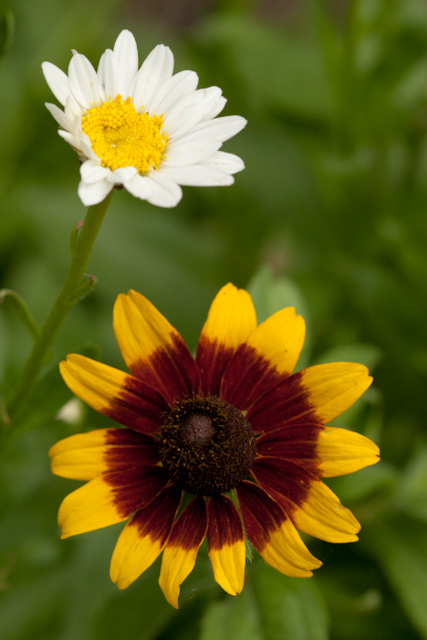
Leucanthemum x superbum 'Becky' (top) and Rudbeckia hirta (bottom)
The biggest clump of daisies front an area that I cleared a few months ago of overgrown nandina.  I didn't get all the roots out so they'll be back, but the Eastern redcedar (upper left) and Mahonia (upper right) are glad to have a little breathing space.  I like being able to see the old tree stump through the gap, which I think is rather picturesque.  That tree came down in 2003.  It was leaning dangerously after hurricane Isabel hit and a fearless neighbor convinced us that we could cut it down together.  It was much more difficult to cut than we anticipated.  I think hackberries must have exceptionally dense wood.  The persistence of the stump might support that theory.
Shasta daisies -- Leucanthemum x superbum 'Becky'
In another storm several years later, another tree fell and created this gap in the neighbor's fence that has never been fixed.  The "borrowed view" includes a rusty wheelbarrow... and LOTS more sun for these crocosmia that exploded into bloom from complete obscurity.  I hadn't even known they were there.
Crocosmia crocosmiflora
Next are three views of the Butterfly garden.  First, daisies and cannas in the foreground with Rudbeckia hirta (the annual black-eyed susan) and Bee Balm in the background.

Canna indica, Monarda didyma (probably 'Raspberry Wine'), Rudbeckia hirta, Leucanthemum x superbum
Here are the daisies again with white obedient plant and a blue glass bird bath, with the foliage of swamp sunflower beginning to tower over everything, and a rosemary shrub in the background.
Leucanthemum x superbum and Physostegia virginiana 'Miss Manners'
I think the blue speedwell in the next photo combines beautifully with everything.  It's taller and airier than other speedwells I see, which is part of what makes it combine so well, I think, but also makes it hard to photograph well.  I love it with black-eyed Susans and with purple coneflower.  It was not well labeled when I bought it and that was years and years ago.  I'm not sure about the species, but I think the tall veronica is longifolia. (Any help would be appreciated!)

Echinacea purpurea, Veronica longifolia (?), Rudbeckia hirta
I don't have a lot of roses, since they are a favorite snack of deer, but I have never bothered to remove the ones that the previous owners planted.  This one hides in shrubbery until it towers well out of the deer's reach (or mine in fact), and then blooms about ten feet in the air, mingling with the leaves of the sweetgum tree.  I don't know what it is but it seems very common around here.  In fact, I wonder if it's blooming from the rootstock of grafted hybrids that passed away long ago.

Unknown rose
The last photo is in the front of my house.  This is the bed that was covered in a swath of chamomile in the spring, and later with black-eyed susans (again, the annual kind).  All of these are self-sowers, as are the sulpher cosmos you see now.  This is also where I put basil every summer.  This year I'm trying a "lettuce leaf" as well as my favorite Genovese.  This year I mulched with compost to improve the soil.  I hope that doesn't prevent the chamomile seeds from sprouting.  I might sow some seed from a fresh packet for insurance, but it didn't prevent the cosmos coming up, so I guess it'll probably be fine. In fact, you might spot a squash of some kind, just above the lettuce leaf basil in the photo -- that came with the compost I think.  I guess I'll pull it ... maybe later.
Rudbecka hirta and Cosmos sulphureus

For the record, some flowers that are also blooming but not shown: abelia, butterfly bush, doublefile Viburnum (very late blooms, I think), Annabelle hydrangea, mophead hydrangea, Rose-of-Sharon liatris spicata (going over), Evening primrose, four o'clocks, sundrops (just a few last blooms), pickerel (just finishing), oregano, cerise queen yarrow, gaura, black-and-blue salvia and lots of annuals (lantana, zinnia, pentas, sweet alyssum, and still a few larkspur blooms) and another still remarkably early New York aster bloom.

Thursday, July 12, 2012

Fragrance in the Garden, Another Ruling Passion


Lilies!!!!  Oh, I'm so, so glad that the lightening bolt hit and I finally realized that I CAN have lilies in my garden!  For several years after I moved to this house, there was a lily that would sprout and bud each year, only to have the buds be eaten by deer.  The previous owners had a dog, who would keep the deer at bay, I suppose.  But I have no dog, and therefore, I figured, could have no lilies.  I never even found out what color that lily was before it eventually gave up the ghost.  I never planted any others, of course.  Who sows heartbreak in their garden on purpose? 

Then I talked to my green-thumbed hairdresser who casually mentioned the dozens of lilies she has growing in pots.  In pots!  That was the lightening bolt.  Last spring I ordered some Casa Blanca lilies and put them in a big pot on my deck where the deer can't reach them, as an experiment.  It worked!  Now it's their second summer and they are blooming again.  Next year maybe I'll even get more.  In fact, I probably need to divide these up into two or more pots because they are significantly more floppy this year than last year.

I think lilies are beautiful but the main reason I don't want to live without them any longer is their fragrance.  Fragrance is one of my true garden pleasures, very high up on my lists from the Ruling Passion Exercise from Rand Lee's Pleasures of the Cottage Garden, which I wrote about in an earlier post.  Lilies are more strongly fragrant than anything else in my garden.  I had noticed buds on the lilies in the morning before they first bloomed, but it was the fragrance that alerted me that they were beginning to open.  Incredibly, the fragrance of this year's first lily wafted out into the garden when the flower was only open about this much:


This is a good month for strongly fragrant flowers in the garden.  The butterfly bush has been especially floriferous this year and my husband even commented about its fragrance.  I have it planted just next to a path that I travel all the time to get to the shed and compost pile and the fragrance is strong enough to catch your attention without you having to stop and sniff.
The butterfly bush is probably past its peak, but still blooming.  Just coming into their peak, however, are the four o'clocks.  I let four o'clocks self sow and consequently have a big enough drift of them to waft their fragrance into the evening air.  I have two kinds, a very tall off-white which is not blooming yet, and the multicolored "Miracle of Peru" which can have majenta, white, or yellow blooms as well as striped, zoned or spotted blooms of multiple colors.
I would love to have fragrant flowers in bloom all the time.  I have many flowers that are fragrant if you get close and sniff, but not so many like these whose fragrance drifts afar.  Both are a pleasure in the garden, but the flowers that meet you more than halfway, wafting their fragrance over passersby, are a special joy in the garden.

Tuesday, July 10, 2012

Gardening in Sunglasses


Virginia creeper, Parthenocissus quinquefolia
It's been quite hot and sunny here the past two weeks and my gardening has been limited to brief sorties into the glaring, humid heat.  When I went out around noon it was 95 degrees in my Zone 7b part-shade backyard and 105 in my Zone 8a full sun front yard (my house is probably not literally the boundary between horticultural zones, but it often seems like it).  My sunglasses, usually not worn while gardening, gave everything a surreal look, and inspired these photos.  No, I didn't put sunglasses on my camera, but I went for subjects where the high contrast between the light and the dark really stood out to me.  The first subject that caught my eye was the Virginia creeper above.  The glowing red and green of the sunlit stems and leaves contrasting with the dark grain on the brown fence is what caught my eye.  I didn't quite capture how this looked through sunglasses but it's a fun photographic experiment.  
Shasta Daisy, Leucanthemum x superbum 'Becky'
Next up is Shasta Daisy.  In these lazy, hazy, daisy days of summer, I always enjoy seeing the crisp white of the daisies.  With sunglasses on, the white jumps out against the dark background of the evergreens behind it.
Hydrangea arborescens 'Annabelle'

Similarly, a beam of sunlight playing across the gigantic flower cluster of Hydrangea arborescens in my shady side yard brings out the cool buff white of the bloom.  I love hydrangeas and this buffy color seems to really add to the grandmothery charm of them.
Blue-eyed grass, Sisyrinchium (atlanticum? angustifolium?)
My final photo is blue-eyed grass, a wildflower I have encouraged in my garden.  With sunglasses on, it seemed to me that these tiny blue flowers really jumped out of the shade.  The contrast of the blue with the yellow center and pollen grains stands out boldly in shade, too.  I don't think the two plants are closely related, but this color combination had a similar effect on me when I noticed a spiderwort flower in deep shade in the very same part of my garden, in another post, in May.